| 作者 |
 [贴图]北京奥林匹克建筑风采(一) [贴图]北京奥林匹克建筑风采(一) |

 |
抢注G8
[博客]


头衔: 海归中校
声望: 教授
性别: 
加入时间: 2007/02/17
文章: 836
来自: 苏州
海归分: 52976
|
|
|
作者:抢注G8 在 海归茶馆 发贴, 来自【海归网】 http://www.haiguinet.com
Innovative Buildings
Beijing won its bid to host the 2008 Summer Olympics in July 2001, and the city promptly geared up some serious plans for architectural planning and development. The city's efforts, for the most part, have paid off, with beautifully functional buildings to show off to the world. Here, check out some of the most innovative structures built in time for the opening of the Games.

National Stadium
Architects: Herzog & de Meuron
The $423 million National Stadium has become a rare architectural celebrity. Everyone calls it the "Bird's Nest," which in China means it is something much prized. Because the architects disliked the massive parallel beams necessary to support the retractable roof, they developed a lacy pattern for the other steel elements to disguise them. Although the stadium's curving steel nest grabs the most attention, the building actually combines a pair of structures: a bright-red concrete bowl for seating and the iconic steel frame around it.

National Swimming Center
Architects: PTW Architects, CSCEC+Design, and Arup
Called the Water Cube (even though it's a box 584 feet square and 102 feet high, not a cube), this building's skin is made of ethylene tetrafluoroethylene (a transparent form of Teflon) cells with either 14 or 12 sides. A space frame assembled on site from 22,000 steel tubes welded to 12,000 nodes holds the cells in place and provides a column-free structure with spans of 396 feet in either direction.
Digital Beijing
Architects: Studio Pei-Zhu
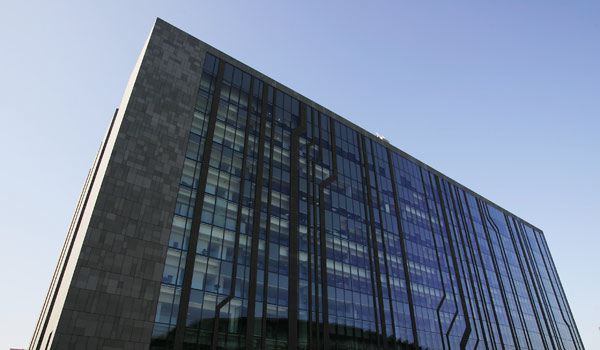
Digital Beijing, a nine-story, 1-million-square-foot building, rises solemnly just northwest of the effervescent Water Cube and the curvaceous Bird's Nest. The building will serve as the control center for the Olympics, home base for technical and security teams, and as a hub for the routers, computers, and servers needed to run the Games. Inspired by computer circuitry, the architects organized the building into four parallel slabs that recall a set of motherboards.
Terminal 3 at Beijing Capital International Airport
Architects: Foster + Partners and Arup
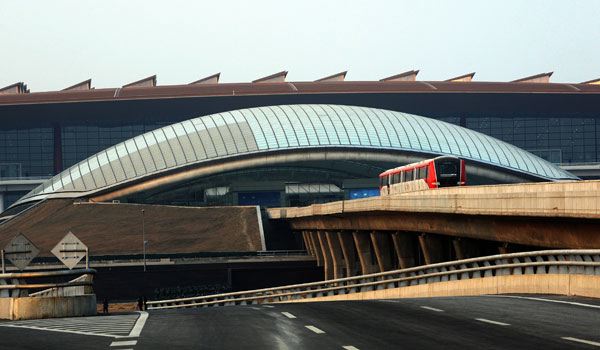
Terminal 3 reimagines circulation for passengers and vehicles alike, resulting in the world's biggest airport building. Terminal 3 measures almost 14 million square feet and cost $3.65 billion to build. It comprises three buildings, aligned on a two-mile-long, north-south axis, that form an elongated hourglass shape in plan. Columns at the center of the canopy are painted red, while outlying ones fade to orange then yellow—all part of a sophisticated color scheme that plays on traditional Chinese themes.

National Center for the Performing Arts
Architects: Paul Andreu Architect Paris
Ultimately, for all the time (eight years) and money (at least $400 million, in a country where construction costs are minimal) that went into it, the Center doesn't pack much of a punch. Andreu's titanium Egg (the Center's nickname) has a brushed texture, perhaps to prevent glare—though Beijing's polluted air usually does the trick. It is so carefully detailed that its surface is scaleless; except when window washers are climbing the exterior, it is impossible to grasp the building's size.

China Central Television Headquarters
Architects: Office for Metropolitan Architecture
A radical, looping structure, the headquarters of China Central Television (CCTV) stands as an antidote to the typical skyscraper. With its dramatic overhang suspended 36 stories in the air and a diagonally braced, continuous-tube frame expressing the forces of its structural system on its facade, it became a Beijing landmark even before its completion.
Olympic Green
Architects: Sasaki Associates
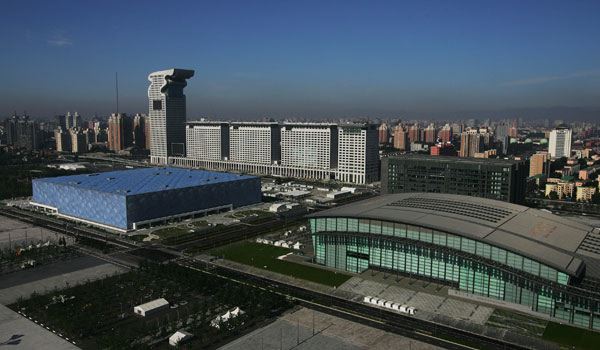
Olympic Green holds 50% of the competition venues for the Olympics, and is located at the north end of the central axis of Beijing City. Sasaki saw its job as creating a framework for the Olympics as well as integrating the 2,800-acre site with the city as a whole. The design comprises three key elements: a Forest Park on the north, a diagonal Olympic Axis connecting existing sports facilities from the 1985 Asian Games to the new venues for the Olympics, and a Cultural Axis extending the ancient imperial route that runs north from Tiananmen Square through the Forbidden City.
Archery Field
Architects: BlighVollerNield with China Construction Design International
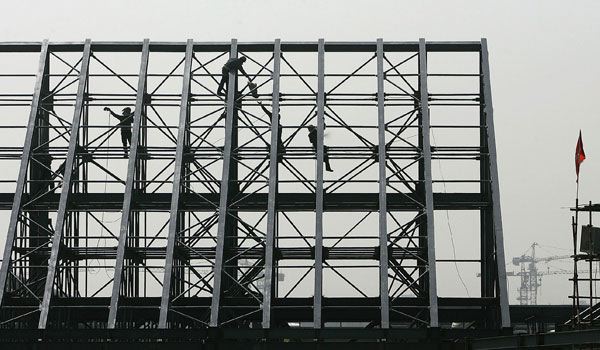
A temporary facility (shown here under construction), the 93,000-square-foot archery center comprises three fields: one for the preliminary rounds and two for the medal competitions. The project provides seating for a total of 5,384 people; fans at the final-round competition field will sit in 46-foot-high stands that are the steepest of any outdoor venue. After the Olympics, the prefabricated steel frame, along with other materials, will be recycled.
作者:抢注G8 在 海归茶馆 发贴, 来自【海归网】 http://www.haiguinet.com
|
|
|
| 返回顶端 |
|
 |
|
-
 [贴图]北京奥林匹克建筑风采(一) -- 抢注G8 - (5903 Byte) 2008-8-02 周六, 02:42 (1562 reads) [贴图]北京奥林匹克建筑风采(一) -- 抢注G8 - (5903 Byte) 2008-8-02 周六, 02:42 (1562 reads)
|
|
|
|
您不能在本论坛发表新主题, 不能回复主题, 不能编辑自己的文章, 不能删除自己的文章, 不能发表投票, 您 不可以 发表活动帖子在本论坛, 不能添加附件不能下载文件, |
|
|


